EN
Blog
Have I landed on a highway?
Yesterday’s landing, deboarding, and departure from the Madeira airport were all pretty much the same as the many other airports I’ve been to in my life. But things were about to change in a surprising way.
Today, while driving a rental car, the expressway I was on went below what at first seemed to be a huge highway, supported by an uncountable number of columns. The sight was already impressive, but when I reached the other side and looked in the rearview mirror, I was astonished by what I had just noticed. I had driven below the airport runway.
But that’s not all.

The underpass had many public spaces, such as sports courts, a skate park, a spacious parking lot, restaurants and even a boatyard. Yes, boatyard. Of course, I had to come back at the end of the day to check it all out.
My photos are incapable of accurately depicting the size of the space. It is impressive. According to Wikipedia, there are 180 columns. And in one of Tom Scott’s videos, I learned that they are 50 meters tall, which is another crazy number when we remember that planes are landing and departing from the “roof” above.

His video also explains the reason for the airport’s location. In his words, Madeira is one huge mountain just sticking out of the Atlantic Ocean. And I can confirm that after spending the day going through dozens of the over 150 tunes on the island. It’s hard to imagine something like this, but you can’t drive for more than a few minutes before you come across a new tunnel.
In other words, this was the only place flat enough to build the first runway, which, by the way, was shorter. When the island began to attract more tourists and the planes became larger, it was extended with a platform over the columns, since a landfill was not feasible.
I had a lot of fun geeking out below the airport, and thinking about humankind’s ingenuity, which never fails to impress me. However, this is an amazing island with remarkable sights that humans will never be able to build. Some of them have already blown me away, but there’s still so much to discover.

Have a lovely week, Vlad.
Choose Evernote instead
Being good at something doesn’t mean it’s easy or that everyone will be able to do it. After helping clients for more than a decade, I can confidently say that the number of people who are not good with technology is much larger than we think.
Today, I started helping a new client who had already told me about his lack of proficiency in technology. In situations like this, Evernote is always my top choice because it’s easy to understand and use.
In about 20 minutes, my client was comfortable with the user interface and the simple structure of notes and notebooks. Tags and tasks were also part of the explanation, but I told him to ignore them for now. Even in such a short time, I was able to show him all the basics and how Evernote Home can be used as a summary of all the information he has in the app.
Next, I helped him strategically think about and create some notebooks that he’ll be using to add content for the next few days.
In half an hour, a person who is very uncomfortable with technology was already creating notebooks, adding information, and moving notes to organize things on his own. That’s how intuitive Evernote is.
If everything goes as planned, he will arrive at the next session with many more notes and some discomfort with organizing and finding information. Yes, you read that right. It is intuitive, but it can’t do miracles.
This is when we’ll start creating his mindful workflow. I’ll be helping him make sense of all his content while introducing strategies using tags, widgets, or whatever else. It will all depend on how he describes what he is having a hard time finding or doing.
Baby Steps
Not only is he uneasy with technology, he also has his business and personal life activities to take care of. Like several others in his position, he cannot afford the time it takes to learn the fancy apps and methodologies productivity gurus love to sell as magical solutions.
That’s why I try to constantly remind myself that many people can only improve their lives with technologies and workflows that are straightforward to understand and use.
That’s it for today. I hope you have a great week.
Goodbye, Maccast
The news is from December 2023, but I’m still processing it. It is, honestly, more likely that I am in denial.
The Maccast was the very first podcast I discovered when I started listening to them in 2005, and it was the only one I never unsubscribed from. But the streak of 18 years has ended.
Even though I’m still a subscriber, Adam told us that the December show marked the end of the Maccast.
Community
The Maccast was more than a mere podcast; it was a genuine community. Adam’s expertise, knowledge, and unwavering dedication to research and learning were evident throughout every episode. But if he didn’t know how to do something or answer a listener’s question, he would ask the community for help to share the feedback on the next show.
For example, [[vladcampos.com/Timeline/Blog/2000s/2007/2007-03-18 The intricate task of replacing the iBook G4 hard disk|after replacing my iBook G4 hard drive in 2007]], I emailed him about a mistake I made. As usual, he shared it with the community in one of the subsequent episodes. I was in the middle of a run listening to the show, and suddenly, there he was talking about my email. I’m pretty sure the information helped someone out there.
The feedback loop made us feel like we were all part of a group of people who were constantly helping each other. It was as if we met on a weekly basis by listening to Adam, the conductor of the orchestra. It was amazing how passionate he was about the community.
Inspiration
It’s 2005, and I’m halfway into a big change in my life. If you read my recent article, this was when I was working for the ‘booming telecommunications industry’ after my failure as an entrepreneur.
The iPod Shuffle was released in the same year, and I decided to finally try Apple’s new gadget. Because of this, I had to use iTunes all the time and found the Maccast, a podcast produced by Adam Christianson.
I was so blown away by what he was doing that I picked up a cheap microphone, learned how to edit audio, and how to write the RSS feed to get the podcast on iTunes. If I am not mistaken, it was hosted in an evolution of GeoCities, which was at that time owned by Yahoo.
Back then I was unhappy with my day job, and producing my podcast brought me a lot of joy. All my research would happen during the week, sometimes during lunch, and I’d record and edit the podcast on the weekends.
At that moment, I was already a blogger, but my podcast, inspired by Adam, marked a significant shift in the medium I began using to share content. It led to the creation of my first YouTube channel in Portuguese in 2016 and, more recently, the one in English. In hindsight, it is possible that the sharing and teaching format of the Maccast may have influenced the tutorial format of my podcast and YouTube channels.
Companion
At the same time I discovered the Maccast, I developed the habit of running. The Maccast then kept me going as I ran my first 15K. I took the Maccast with me on numerous flights to remarkable destinations across the globe. It was also a companion in less interesting places, such as traffic jams. But that’s what friendship is supposed to be like, right?
My friend traveled with me on trains and boats. Subways. Buses. We took the Caltrain together to visit 1 Infinite Loop, Evernote, and Flipboard. It followed me when I moved from Brazil to the USA, then Chile, and finally Portugal.
For the past 18 years, it has been a significant presence, and it has had a profoundly positive impact on my life. I’ll eventually come to terms with the fact that my buddy is no longer with me, but I can’t unsubscribe from the Maccast just yet. It’s so hard to let it go.
But I’m also happy for Adam. He’s starting a new chapter in his life, and I wish him all the best!
Thank you, Adam!
Rabbit OS
The Large Action Model (LAM) running on Rabbit OS is a fascinating use of AI. But, if I’m being honest, I was really attracted by the retro vibe of the Rabbit R1 device itself. It’s so cool.
Heads up! Starting with this post, I’m going to add a little mess to my online presence for a while. I’m trying out Microblog’s cross-posting feature to see if it works for me. The original posts added to vladcampos.com will be automatically shared on Bluesky, LinkedIn, and Mastodon.
There’s no such thing as the perfect App or a magical template
Don’t get sucked into the online drama about productivity. Unfortunately, it’s not an App or other people’s methodology that will help you.
This is the story about how many years ago I was hypnotized by magical solutions that never worked, and how my journey made me realize that everyone can find the perfect system. Yes, you can do it too. It will require more work and take longer, but it’s worth it.
Different, different, and different
Do you remember my article about letting things get messy for a while? This is precisely what I did when I started moving my notes from Evernote to Obsidian. Although both Apps share many similarities, there are still plenty of differences that make it impossible to just use my Evernote system on Obsidian.
If you have already struggled to organize or be more efficient, you may know that it is equally inefficient to use someone else’s workflow to solve your problems. We are all different people going through different moments in life and exposed to entirely different circumstances. I hope I said ‘different’ enough times because it is the most important word in this article. You must realize that your needs are unique.
The early stages of my journey
Years (decades 😮) ago, when I started looking for a solution to my workflow problem, I did what I see many people doing today. I tried to use someone else’s methodology. When that failed, my initial thought was that I was the issue.
Maybe you have been through this too. This is precisely that moment when the evangelists usually show up and tell you that you don’t need to use it the way the ‘guru’ created it.
—You can simply adapt it to your needs.
Hmm. That’s quite convenient, isn’t it?
Well, if I’m adapting something, I better create it myself. And this is when I began experiencing, let’s call it, ‘dishonest thoughts’. If I were to develop my own methodology, I could potentially commercialize it and generate some revenue.
That idea stuck with me for a while, but several books later, I came to the conclusion that all of these so-called incredible methodologies are, in reality, variations of something that came before. Why would I want to add another layer to the onion?
At this point in my career, around the turn of the millennium, my inexperience was evident. Although I gained a lot of knowledge from my degree as an economist and all the books I read about project management, my first company was a disaster. However, it was not all in vain.
That unique combination of failure and acquired knowledge helped me start a career as a project manager in the booming mobile telecommunications industry. But what if I told you that the companies I worked for were also having trouble creating and managing effective processes? Wow, what a relief. It wasn’t me; the problem was significantly more extensive than I initially anticipated.
Figuring things out together
Twelve years later, in 2012, I realized I had enough experience to start another company. But this time, I would do it alone as a consultant. I used social media to spread the word, but I never talked about solving difficulties with this or that particular technique. It was all about collaborating and figuring things out together like I learned to do during my telecommunications career.
Guess what the people I attracted were telling me when they arrived at the discovery meeting?
—I’ve tried countless different methodologies and Apps, but nothing worked. I don’t know what’s wrong with me.
You know what? I still hear this from almost all my clients nowadays.
The first thing I ask all new customers is how they do their job. I don’t even use the word workflow. What I say is, ‘Pretend I’m going to start working for you today. Explain to me the work you do.’
That’s harder than you think and people tend to drift the conversation towards the Apps they use. This is when I reply, ‘Forget the Apps. Pretend they don’t exist and tell me how you do your work. I want to understand the process, the stages, the problems, etc.’
People are so obsessed with the idea that something else is doing the work that I always face several moments of silence after that simple question. It’s really fascinating how it proves my point. People think that something outside is the solution, but they already have the answer with them all the time. I’m merely a facilitator. I provide guidance, and they find the answers by themselves.
Anyway, back to the client. After taking a deep breath and receiving some direction from my side, the explanation begins. This is usually when I see the relief on their faces. It’s as if they broke free.
Long story short, it’s only after I understand the workflow that I start helping them build a system. To make the system more efficient, we’ll certainly use some Apps, but only as tools. Always remember, Apps are not solutions; they are merely tools. And it’s all done together because this is not a magical solution. My main goal is to help the client build its own system.
The good news is that you can solve this by yourself too. It takes more time, but eventually, you’ll have the perfect system for yourself. Start by mapping your work and needs. Ignore the Apps and methodologies. Think of your work as a workflow. One step after the other. Once you grasp that, allow yourself to feel a bit uncomfortable. Don’t add tools just yet.
While you are experiencing the hard work and maybe even the mess, think about what you need to do to make each step of the way more efficient, and then look for the tools that can help you. Congrats! You just built a mindful workflow.
I know it’s easier said than done. After all, it took me some years to figure this out. Maybe the video below will help you. But as you watch it, please pay attention to the process that led me to the dashboard, not the plugins I’m using. I’m never looking for a silver bullet. I’m sorry to be the one telling you this, but that doesn’t exist. Anyway, as you watch, notice that as I go I’m constantly trying to find something that will solve a very specific next problem.
The truth is, you are the only one who has the correct answer. Keep asking yourself what you need to do next to reach the following level of the game.
You can do it!
Isn't it nice when technology makes things simpler?
As I mentioned in yesterday’s article, there are still certain steps to take before I have Micro.blog set up the way I intend it to be. This is a test of two new configurations I’m working on.
If everything goes according to plan, this post will be automatically added to Bluesky and LinkedIn. Cross-posting to other services is possible, but I’m taking it slow and starting with only the ones above.
The Micro.publish Obsidian plugin is another thing I’m trying with this post. It has been created on an Obsidian note and will be converted into a blog post with very few mouse clicks. In other words, you are witnessing the tests and preparation I do when producing a video for my YouTube channel.
What inspired me to move from Obsidian Publish to Microblog?
TL;DR: a gateway to a thriving online presence
What if I told you there is a tool that can replace your blog, website, newsletter, podcast, bookshelf, and more? 🤯 It’s even compatible with the ActivityPub protocol.
In a recent article, I discussed how owning a domain and using permalinks can help you seamlessly move from one hosting service to another without losing your audience. Then I published another article devoted to describing a similar approach for your social media presence
Well, there is a way to combine the best of both words in a single place. Better yet, what if you could also include other services, like a newsletter? Have I mentioned that the price is a fraction of what you would pay for a combination of similar services from other companies?
Since this is too good to be true, I feel like a disclaimer is needed. No, this is not a sponsored post. I paid for my subscription, and no one at Micro.blog had any input on this article or any content I’ve been publishing about them. I’m doing it because, as you already know, I’m an enthusiast.
Anyway, I hope you’ll find the information below helpful.
My previous set-up
I have an institutional website for many years, but have been posting my articles on Medium for a long time to take advantage of the algorithm. Two YouTube channels, one in Portuguese and another in English, a newsletter hosted by Substack, and a presence on multiple social media platforms.
I believe that diversifying like this helps spread the word because I can take advantage of algorithms from multiple platforms. However, my entire business is run by myself, and things can quickly become overwhelming. So much so that last year I was forced to pause my newsletter for several months.
Why Obsidian Publish didn’t work for me
When I moved my website from WordPress to Obsidian Publish, I was trying to simplify things by having my notes and the website in the same tool. But if I’m being honest, it ended up creating more work. Not because of the publishing process, which is easy and straight-forward. The problem was me. I love taking notes, so I suddenly felt compelled to share as much as I could, and that came with its own set of complications.
Instead of just taking notes, I was constantly thinking about how to structure my notes to have them ready for use and, at the same time, good for publishing. Furthermore, my folders structure became a little chaotic due to the numerous additional files needed to create a website. I was constantly afraid of accidentally moving or deleting files.
There’s no way to have a blog when using Obsidian Publish, but I was kind of okay with that because Medium was my blogging platform at the time. I also read numerous complaints about SEO, but I’m not a specialist on this topic and cannot say much about it. However, the final hurdle was the verification process at Mastodon, which could never identify the needed code because of the way Obsidian Publish builds the website.
I couldn’t care less about verification, but I have already been impersonated, and unfortunately, some people following my YouTube channel in Portuguese were scammed. After that, I’ve been constantly trying to do all I can to prevent it from happening again.
What’s next?
In 2022, I tried Micro.blog, but it lasted for less than a year. It was the way the platform handled engagement that made me give up on it. If you would like to learn more about it, have already explained everything in more detail in another article.
For those of you who are not aware of Micro.blog, it’s a complete solution. It is a space to share short posts like ‘tweets’ and pictures, a blog, a website, a newsletter, a podcast hosting service, and many other amenities like bookmarks plus a ‘read it later’ with a highlights feature, a bookshelf, and more. And the price is amazing. US$5 or US$10, depending on the features you need. To learn more about it, I suggest you watch the video below. But beware that it doesn’t cover all its potential.
I still have my two YouTube channels, and they are not going anywhere. But I reactivated my blog on Micro.blog. I won’t stop publishing the articles on Medium, but I started adding a Canonical Link.
Micro.blog can be set to share the same content on other websites, like Medium. However, for now, I’m doing it manually.
ActivityPub
Regarding the newsletter, I am still using Substack, but I also intend to transition it to Micro.blog in the future. However, the feature in which I’m most interested is precisely the one that made me live in the first place. The blog is compatible with ActivityPub and, as explained in another article, anyone can follow it from any Fediverse service.
The strategy Flipboard is using inspired me. Their Mastodon instance — flipboard.social — works as a Twitter alternative, where the community can share and interact with one another. As for flipboard.com, it is being converted to be 100% compatible with the ActivityPub protocol. If all of this seems too much, please watch the video below. It may help you better understand the terminology I used above.
My plan is to rebuild my Twitter community on Mastodon, while Micro.blog will host my blog, site, and other services, acting as a central point to help people access all the content I’m constantly sharing online.
Nostalgia
This doesn’t necessarily count as a rational reason, but since when is feeling at home something that’s rational? When I first tried Microblog in 2022, I noticed a familiar face among the team: Jean MacDonald. I had the opportunity to meet here only twice for brief moments during the 2013 and 2014 Evernote Conferences. Nevertheless, the conversations we had were so pleasant that those moments remain etched in my memory to this day.

In conclusion, there’s nothing terribly wrong with Obsidian Publish. On the contrary, during those months I used it, it proved to be a fast and reliable service. But there’s no blog or ActivityPub there, and those are some reasons why Microblog is gradually becoming my online home.
Another reason, as I mentioned before, is that Micro.blog can work as a hub for publications. At some point in the future, when I finish my migration process, I’ll start using it to automatically cross-post content to other social media platforms.
Combined with all the other benefits I mentioned above, I’m expecting Micro.blog to significantly reduce the work I currently do every time I publish a new article or video.
Obsidian's new editor is a big step in the right direction
As a user, I enjoy Markdown. However, as an instructor, I almost hate it. Most of my clients find it challenging to understand and use, especially in a world where every basic text editor has a formatting bar.
We, the Markdown enthusiasts, see it as a great invention, and it is, but it is meant for people like us. My first computer was an Apple II+ where I learned to write programs in Basic. If you are a Markdown lover, I bet you have a similar background or passion for technology. But how many people do you think there are like this in the world?
The good news is that the Obsidian team seems to be steadily figuring out a way to allow users to pick their preferred text formatting method without any hassle.
My background
I learned how to create my first website back in the 1990s by looking at other people’s source code. But that’s as far as I went. I was unable to learn any other advanced programming language, even those that are only slightly more complicated than HTML. However, having this background made me look at Markdown and find it to be the easiest thing to learn and use on the planet.
I’m confident to say that people with similar backgrounds, for example, Excel enthusiasts, will also find Markdown super easy to learn and use. However, that is too much for people who only use computers as basic tools. I know this because I have seen it happen to my clients time and time again.
Trello is a great tool I use a lot in my consulting business, but it took them ages to adopt a regular text editor. Before that, the only way to format text was by using Markdown, and only a very few of my clients were willing to use it. It was rare that anyone took the time to learn it.
An entry barrier
All that said, I always saw Markdown as one of the biggest barriers to any non-tech-savvy person thinking of adopting or switching to Obsidian. Again, I’m not making assumptions here. I don’t have numbers, but I’m constantly hearing complaints from clients and reading comments on my videos and articles about how complex it is.
It’s true that one has to memorize just a handful of symbols to use it, but that’s not natural, especially when all the other text editors regular people use have a formatting bar. Most people don’t even use Ctrl+B, I, or other formatting shortcuts. Clicking on icons is significantly more intuitive.
A big step in the right direction
If you haven’t yet, I invite you to watch the video below and stay with me for a moment while I move items from one column to another on a table using Markdown. No matter how much you love Markdown, that’s insane! It’s a huge waste of time.
Thankfully, Obsidian 1.5 added a terrific table editor while keeping all the Markdown behind the scenes for the enthusiasts. Another important addition is right-clicking a word to format it or right-clicking on the note to add items like tables, paragraphs and many others. Again, the Markdown is still there.
The gradual adoption of more familiar ways to format text is a big thing. In my opinion, this is the way to go. It will attract more non-tech-savvy users while keeping the Markdown layer under the hood.
Great move, Obsidian!
Prisoners of Geography
The first book of 2024. I still prefer eBooks for a multitude of reasons, but bookstores and used bookstores are still the kings of discoverability. I found Prisoners of Geography by Tim Marshall in a random store during my last trip and had already read half of it flying back home.

Will 2024 be my first year without Evernote?
I think it’s fair to say that everyone was a bit astonished when the news broke on the third day of 2023. Bending Spoons, a company barely anyone knew about, had acquired Evernote.
For the past 15 years, I have never considered leaving Evernote. To be more precise, the thought never crossed my mind. Now it looks like 2024 will mean more to me than just a new year. Maybe it will be a year without Evernote. But it’s rare for something so big to happen suddenly. We have to go back to the beginning of 2022 to understand what’s going on.
I was already experimenting with Obsidian for my video production workflow when some of my clients asked me to help them build their workflows on Obsidian. That ended up starting a feedback loop of fresh ideas and more experimenting and teaching. Long story short, by the end of 2022, this learning and teaching system was at full speed. Then, boom! The acquisition news in January 2023. And, let’s not forget the chaos Twitter was in because of its own acquisition. What if Evernote experienced the same fate?
There you have it. It was a perfect storm forming before my very eyes.
What I’m trying to say is that it’s rare for only one event to cause a big change. It is usually the culmination of many small things happening simultaneously that creates the perfect conditions.
Most of my notes—about 80% of them—are still in Evernote. But if I’m quoting Pareto, the 20% of notes I’m using 80% of the time are already in Obsidian. And this makes all the difference. When I need to find something, chances are that Obsidian will have it. Which ended up helping me create the habit of opening Obsidian first. Oops!
Another important aspect of Obsidian is the fact that the mobile clients are fully functional. During short trips or vacations, I do not bring a computer with me, and I can still use Obsidian on my iPad as if I were at my office computer.
It’s not all roses, though
I was an early adopter of Postash.io back in 2014, and I loved the fact that I could convert any of my Evernote notes to pages of a website or blog posts. Sadly, the service never worked properly, and I ended up going back to a conventional website hosting service. Obsidian Publish seemed like the perfect opportunity to try that again, but although it is a very reliable service, it came with its own set of problems. As you already know, I went back to a traditional website hosting service. But this is a story for another day.
For the moment, I will leave you with this. It’s more likely than not that 2024 will be the year I switch from Evernote to Obsidian.
Happy New Year!
L'arbre des 3 Frontières
Thanks to the Schengen Agreement, I started my day in Luxembourg, visited France for a while, and then had lunch in Germany. The fact that anyone in the EU can freely cross borders is a wonderful thing that should never be taken for granted.

My travel coffee kit
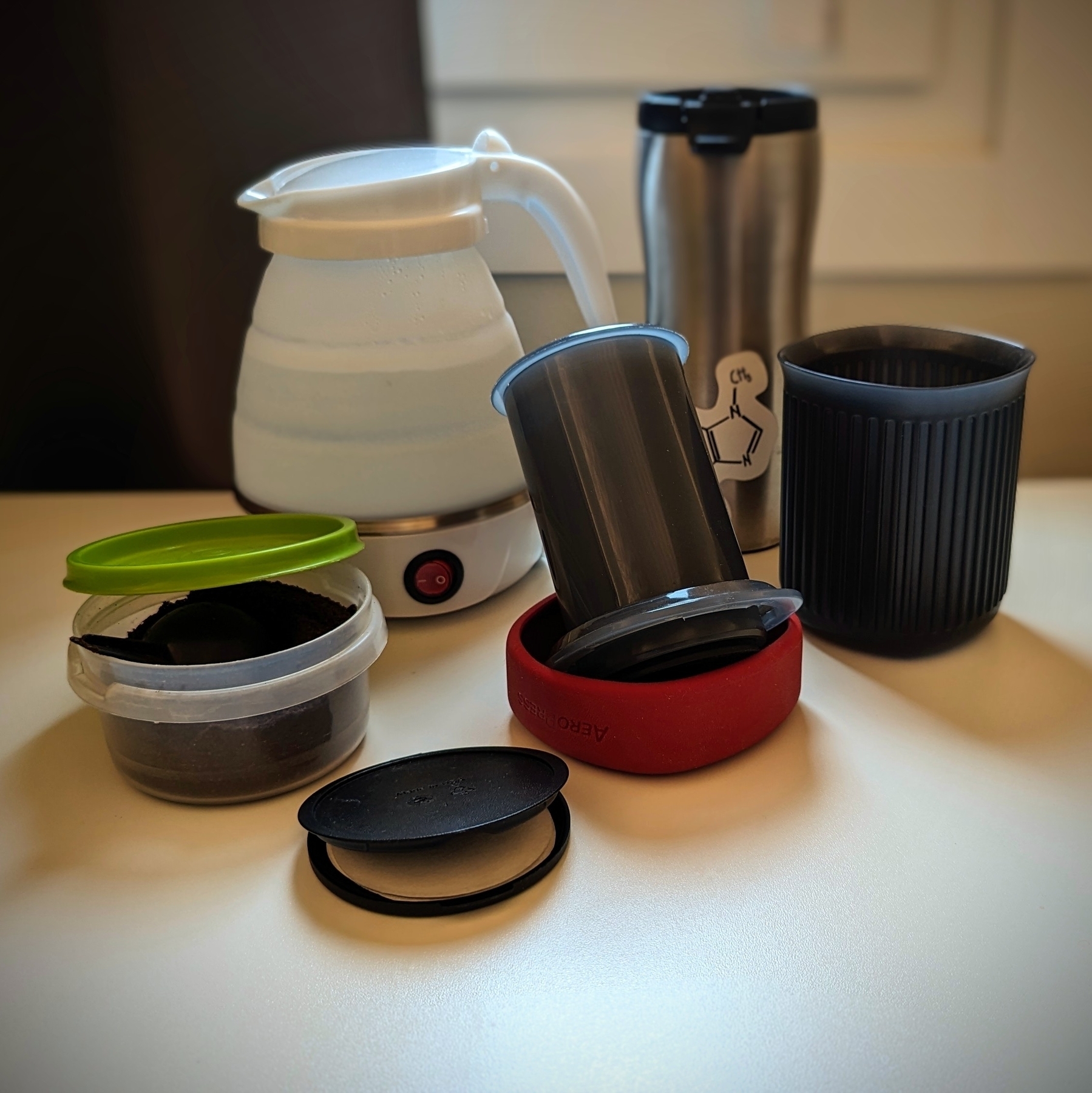
I still use my original AeroPress to make coffee in my office, and for a long time, it was the one I took with me on every trip. When the AeroPress Go was released, I had to buy one and include it in the small 🫣 kit that I always travel with to be able to brew my own coffee every day.
Back to the Source: Revisiting Weaving the Web by Tim Berners-Lee
To give you a sense of how long ago I read the book Weaving the Web, I still had a Walkman lying around, and since I accidentally picked it up in cassette format, that’s how I “read” it. Yes, you got that right: cassette tape.
Regardless, I remember hearing Tim Berners-Lee explain that his original concept for the Web was a more interactive knowledge-building and linking process. I don’t recall his exact words, but this was the idea. At least, this is what my memory tells me. Which reminds me of another great book, Memory Illusion by Dr. Julia Shaw. But I digress.

That stuck with me for a long time because, for many years, all we had were websites with static pages. No interaction at all. It was more like a one-way knowledge flow, but it was a start. Then came the blogs and the comments, but it still didn’t feel like what he meant in his book. When social media started gaining popularity, I thought to myself, “Maybe this is it.” Well, I was wrong. We ended up with a lot of “islands” and too much misinformation.
I don’t think a Web based on the ActivityPub protocol is precisely what he meant, but connecting all these online “islands” feels to me more like his vision. Another step in that direction, if you will.

Anyway, it’s been too long since I read it, and I’ll use the last week of 2023 to revisit it. It’s a great book! Dr. Shaw’s book is also excellent, but it’s more recent, and I have already read it twice.
That’s it for this one. I hope you have a lovely day!
Future-proofing my online presence
My thoughts and opinions on ActivityPub and the Fediverse are numerous, and I am already working on an article to share them with you. For this one, the plan is to explain my strategy to future-proof my online presence.
If you don’t know what ActivityPub and the Fediverse are, please watch my recent video about this topic. But the most important information to understand is that one can follow and be followed, as well as engage, regardless of what social platform is being used.
Many services have been compatible with the ActivityPub protocol for a long time now, but I don’t think we can deny the fact that if large corporations adopt it, the chances of it becoming mainstream are higher. And based on the recent announcement by Flipboard and the tests being conducted by Threads, I’m pretty sure this is what’s happening right now.
Again, I suggest watching my recent video on the topic to understand the details and implications. For now, let us discuss the reasons behind my choice of Micro.blog and Mastodon.
Micro.blog
I believe that Micro.blog is a link between the old Internet, before social media, where people used to write on websites and blogs, and the new Internet that is all about sharing everything.
At Micro.blog, you can make a website with static pages and and also have a blog. The cool thing about the blog is that it uses the ActivityPub protocol. This means that anyone using any ActivityPub service can read and engage with your posts.
But there’s more, or, should I say, less? If you read Manton Reece’s book about starting a Micro.blog, or follow him online, you’ll see that he is really into writing short posts. It is also evident in the company’s name and the blog feature on Micro.blog.
If one writes simple posts, such as tweets, they will be added to the timeline, like what happens on Twitter and other similar services. On the other hand, if a long-form text is created, that will become a blog post like this article you are reading. However, it will also be added to the timeline with a link to the article. And, once again, that timeline is compatible with ActivityPub.
All these means that someone, say, on Mastodon, can follow and engage with all the posts without ever being a Micro.blog user. You can use my blog to try it out. Just look for @vladcampos@vladcampos.com on your preferred Fediverse platform.
There are already many great interviews with Manton Reece about Micro.blog out there, but I’m thrilled to share that he recently accepted an invitation to have a conversation about all this on my YouTube Channel.
But if Micro.blog is both services in one, why would I need Mastodon? Well, a year ago, I tried using it alone, but I had no success. I left because of a design decision. There are no likes or re-posts on the Micro.blog timeline. To explain why I care about it, let’s talk about Mastodon.
Mastodon
When I first heard about Micro.blog, I was already a Mastodon user, where I was building a new community after leaving Twitter. On doing so, I quickly learned how important likes and re-posts are. Because of them, I got to know so many nice people re-posted by someone I was following. The same thing happened the other way around. People re-posting me on Mastodon helped me get noticed by others.
Nevertheless, I fully understand Micro.blogs decision. The goal is to stimulate conversations, but, to be honest, I felt very isolated there. And at that particular moment, I did not have a significant number of people following me on Mastodon, and I still do not. Until these days, I keep discovering interesting people and communities through re-posts.
How is this future-proofing my online presence?
First of all, ActivityPub is a W3C protocol. Then, there’s the fact that major corporations are beginning to embrace it. But the most important reason is that ActivityPub-compatible social media allows you to move between different services and bring all of your followers with you. Let’s say that in the future, Micro.blog adds likes and re-posts and I decide I want to leave Mastodon. I’ll be able to easily do it, bringing with me all the followers, whom, by the way, I prefer to call community.
This is such a win-win situation. Whenever and wherever it pleases me, I am free to move, and I don’t have to ask anyone from my community to move to a different social media platform. Furthermore, if they also wish to move somewhere else, that’s fine. As long as it is compatible with the ActivityPub protocol, neither technology nor CEOs will prevent us from keeping in touch with each other.
The Plan
My website has already been migrated to Micro.blog, but I will continue to post on Medium, which is, incidentally, also in the process of adopting the ActivityPub protocol.
In December 2024 I started the processo of moving my site to Obsidian Publish. In August 2025 I moved back to Micro.blog
Regarding micro-posting, I’ll be doing it on Mastodon. So, if one wishes to follow only my articles or only my micro-posts, they can do so. Or, they can also follow both. And the best part is that anyone can follow and interact with me using any ActivityPub-compatible service. This is absolutely remarkable!
What went wrong with Evernote? How did we get here?
I expect negative comments on every video or article I publish about Evernote now. Sadly, talking about it makes me feel anxious.
I don’t think Evernote is doomed, but there is a profound shift in perception going on. It used to be that going to the Evernote Conference was the most important moment I looked forward to every year. It was great to see my friends, clients, developers, and the Evernote team.
Furthermore, sharing news from the conference or anything else Evernote released throughout the year had such positive vibes. Now, it’s difficult to ignore all the negativity out there.
But the mood didn’t shift at once; it rarely does.
It all started many years ago
In July 2015, Phil Libin stepped down as CEO, and Chris O’Neill initiated a series of changes that made many of us, myself included, uneasy with the future of the company, or, in other words, our notes.
Evernote had a family of companion apps, and the new CEO gradually discontinued most of them, making many of us unhappy. But moving Evernote’s database to Google Cloud and the layoffs kicked off the first negative wave I’ve ever seen. At least, I do not recall anything similar during the Libin years.
I have to believe that from a financial standpoint, moving to Google servers was the best course of action. Even Apple used Google’s service in the early stages of iCloud. And I think they still do. However, the public’s perception was distorted by the way the media covered all the other CEO decisions.
For instance, I recall reading articles that referred to Evernote’s headquarters as a “ghost town.” I was furious about that; it made no sense. Back when Libin was CEO, or, in other words, before the layoffs, I visited the company and can attest that the building was not fully occupied. As far as memory serves, floors one and two were completely empty. Not even desks! The idea was to have enough room to grow in the future.
Nevertheless, I can relate to the anger and frustration people felt. The way the story was told made it hard to tell the difference between noise and reality, which leads me to the topic of communication. I’ve always found Evernote to be terrible at conveying decisions to its users. And the problem is still present. For instance, I believe that transferring operations to Europe was an excellent decision, but again, the public perception was different.
When you are hosting people’s memories, you don’t have the luxury of being as secretive as Apple or carless as a cable TV announcing the new version of its app. Every decision has to be over communicated.
I’m not sure why, but one thing that made me upset was the end of Evernote Market. Possibly because some of the products made it easier to organize things in real life, like we were used to doing in Evernote. Anyway, I was sad to see that go.
[!cite] Over the past few years, more than 800,000 Evernote Moleskine notebooks and 300,000 Jot Script styluses were sold worldwide. Through Market’s website alone, we sold nearly 20,000 ScanSnap Evernote Edition scanners.
Market gave us the opportunity to illustrate the true value of Evernote to folks who hadn’t yet considered a Premium subscription. In fact, nearly half of the folks who shopped the Evernote Market were paying us for the first time.
Ultimately though, Evernote is a software company.
Communication, communication, communication. I don’t have all the facts, and I believe all of us try to make the best decisions based on the information we have available at the moment. But the way the official blog post was written suggests that the Market was successful, “but we are ending it anyway.”
As for:
[!cite] Instead of selling and fulfilling orders ourselves, on February 3rd [2016], we will transition the Market to promote Evernote-integrated products made and sold by our partners at Adonit, Moleskine, and PFU. We plan to continue adding partners and integrations that strongly and elegantly complement Evernote to that list.
The transition lasted for a brief moment. It didn’t take long before everything stopped being sold. I have many items in my collection, but the Evernote Market was much bigger.

Recently, I learned in an interview with Libin that when he was the CEO, the Market was profitable, but its benefits went way beyond that. I messaged O’Neill on LinkedIn months ago, inviting him to an interview on my channel to talk about his time as CEO, but I never heard back.
The last thing I remember from O’Neill’s tenure as CEO was the fervor the company generated on social media to unveil a “fresh brand identity”. Once again, the issue of communication was affecting Evernote. There was a lot of criticism about spending time and money on a logo instead of addressing the problems with the app.
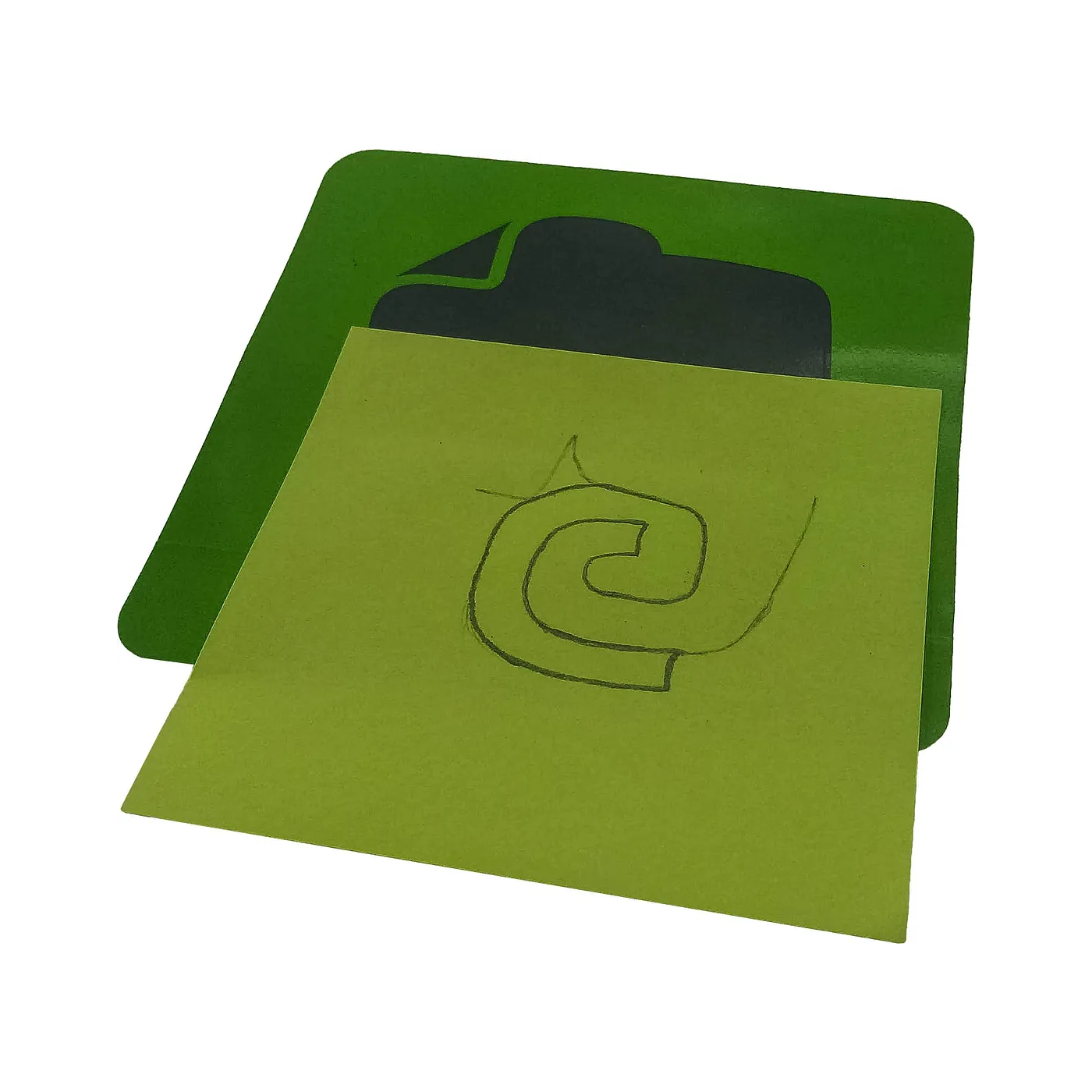
Regarding the old logo, did you know that the elephant trunk is hiding the letter e?
A frustrating web client
If you are a subscriber to my YouTube channel, you know that I try crazy experiments all the time. Well, back in 2018, I tried to run my entire consulting business on a Chromebook. The Chromebook paired with Google Workspace and Trello performed exceptionally well, but the Evernote web* client, which was limited at the time, ended up being a major drawback in my plan.
* It should be noted that the decision to oversimplify the web client was taken when Phil Libin was CEO.
My experiment and what was going on with Evernote (the company) at that time made me think about switching to a different app for the first time. My consulting business is about helping companies build mindful Kanban workflows using tools like Trello, so I thought Notion would be a perfect fit for my notes and Kanban workflows.
I moved some of them, played with Notion for a while, and made couple videos for my YouTube channel in Portuguese, but even though I love all the cool stuff Notion has to offer, the database vibe doesn’t appeal to me. If I were to switch to a different app, note-taking would have to be its main feature. Perhaps that is the reason why I am currently enjoying Obsidian.
Ahead of its time?
Sometimes I catch myself thinking about Evernote’s series of managerial missteps along the way, but analyzing events in hindsight is always unfair. Other times, I believe the problem was timing. It is possible that Evernote was too ahead of its time and didn’t find a way to use this advantage in its favor.
For instance, a couple of weeks ago, I decided to test the Obsidian Map View plugin, and I couldn’t stop wondering why Evernote removed the fantastic map feature the app had back in the day.
Most people don’t even know this, but when we create a note, the app always attempts to save the coordinates of where the note was created. Evernote map view would simply show all notes with coordinates on a map. That’s it. We didn’t have to deal with any configuration.
It was a great feature, as were many others that were discontinued. In contrast, the Obsidian Map View plugin is difficult to set up, but at least it exists for people like me who want to see their notes on a map. Why? Well, you should watch the video below to be amazed by how many interesting use cases people can come up with this feature.
Evernote even had AI back in 2014, but the “A” stood for augmented. Features like context and handwriting OCR were among the many innovations the company came up with. To learn more about the challenges and the ideas they had for the future, I encourage you to watch my interview with Phil Libin on this topic.
Even today, with so many of these marvels gone, it’s still hard to find an app that’s both easy for non-tech-savvy people to use and that also packs in so many useful features.
But when a company stops innovating, others will take over. Steve Jobs famously said that if Apple hadn’t taken the iPod’s market share with the iPhone, other companies probably would have.
Do you remember?
Did you know that back in 1999, in the days of dial-up and DSL Internet, there was a service called Yahoo Briefcase that would create a ‘Y’ drive in our computers and allow us to synchronize files to the cloud?
That’s correct; Yahoo had it many years before Dropbox. But I bet that young people believe that Google and other companies invented services pioneered by Yahoo. The book “Marissa Mayer and the Fight to Save Yahoo!” has some chapters about how Yahoo missed the chance to be even bigger than today’s version of Google. Instead, it ended up as a Verizon subsidiary with a financial channel on YouTube.
Palm’s path was much harder than Yahoo’s. They were inventing a new market, and if that wasn’t tough enough for the team to deal with, the company went through numerous ownership changes and never found its way to a stable future. It’s mind-boggling to me that an entire generation is unaware of the remarkable products this company invented.
If you believe that the idea of having a personal assistant in your pocket was created by Apple with the iPhone, here is a good book for you: “Piloting Palm: The Inside Story of Palm, Handspring, and the Birth of the Billion-Dollar Handheld Industry.”
The Apple II was the first computer I owned as a teenager, but my Palm PDA and Yahoo services were tools I used professionally for a long time, and I still miss some of Palm’s features. I wish these companies had continued to evolve, but, as I mentioned before, market forces cannot be controlled.
A bright future?
The year is 2018, and here we go again. Evernote has a new CEO, Ian Small. I’d say his main accomplishment was solving a problem that no one else had the courage to deal with before him.
Evernote had apps for Android, iOS, Mac, Web, and Windows, but I always referred to them as “versions” because they were so different from each other. The original management team had a reason for this approach, but in retrospect, it never worked well for us, the users. For instance, formatting a note using one of these “versions” would, more often than not, break it in another. However, I believe the worst consequence was that it slowed down innovation.
Evernote 10 was a necessary evil that created so many complications for the end user. It had to be done. It was a long-overdue project. Furthermore, it took longer than expected, and it was hit by COVID-19. And, again, more features were removed from the app.
Can you see a pattern here? From a user’s perspective, Evernote is constantly removing features and working to fix new bugs.
But for the first time, Evernote established an astonishing channel of communication with its users. The behind-the-scenes videos with the CEO, the blog posts, and many other projects created a new kind of collaboration between us and the company.
Small’s courage to rewrite all the clients was both bold and necessary. But it also means that from a technical standpoint, Evernote 10 was an entirely new app, and like every new piece of software, there may be several unknown bugs.
The good news is that 10 opened the doors to innovation. Evernote Home and its great widgets, such as the calendar and filtered notes, tasks, notes filters, and backlinks, came after 10 was introduced. Even the Real-Time Editing feature was being worked on by Ian’s team for many, many months before the Bending Spoons acquisition.
There are frequent complaints about bugs, but the way I see it, Evernote had no other options. They had to deal with the multiple apps that were incompatible with each other. It was either no more innovation or dealing with some bugs for a while.
However, my concern is somewhat distinct. I think Small’s decision to move development towards the “Accomplish Anything” vision was a great idea. The new features his team created brought our notes to the next level, and the way he spoke about Evernote was a clear indication that many more similar features would be coming. Unfortunately, I have no idea what Bending Spoons plans are for Evernote.
I am a fan of Small and his accomplishments, but what I hope to understand one day is why the company was sold. Was it his decision? The board’s? Was it an offer? What happened?
The Bending Spoons era
I have no doubt that Bending Spoons is working hard to fix all the problems they inherited, but they may be running out of time. The bugs, along with the layoffs, price increases, and other unpopular decisions, may be hurting Evernote credibility too quickly. To add more salt to the injury, the connection Small’s team built with the community by being so transparent is slowly disappearing.
I believe Bending Spoons has everything it takes to make it right, but only time will tell if they will be able to replace the iPod with the iPhone or end up like Palm, Yahoo, and so many other fascinating companies that are long gone.
Building your brand out of a domain name
TL;DR: Social media is a great space to become known, create authority, and grow your audience, but you need a home base that is yours. Buy a domain, create a basic website if you don’t want to spend too much time on it, and always, always promote it on all the social media services you are using.*
How having my own domain gave me so much freedom
Like many of us, I have grown tired of social media, and in recent years my posts have shifted to basically promoting the content I create and getting in touch with other creators and potential partners.
About 20 years ago, after using Geocities and other similar services, I decided it was time to establish a web presence by creating a self-hosted WordPress website with my name as the address. When that became too technical for me, I switched to WordPress.com. But I didn’t stop there. I decided to give Squarespace a shot long before it became the recognizable name it is today, primarily because I wanted a more professional-looking website.
Many years after that, I moved to Google Sites because I was already paying for it on my Workspace subscription. It ended up not working out for me because of some limitations, and last year I went back to WordPress to give it another try.
Between all the switches described above, I also tried Micro.blog and Postash.io for a while. More on this shortly. Finally, last week I moved to Obsidian Publish.
Despite all these transitions, people could always find me visiting my website. Having my own domain and using something called permalinks made this possible.
What is a permalink?
If you search for ‘what is a permalink?’ on Google, many of the results will be explanations based on the SEO benefits. That’s a good reason on its own, but I also think they are a great tool for moving your website to another hosting service. Let me tell you what I mean by this.
This was precisely what I did when going from one service to another. Many times I used the moving opportunity to remove some posts and rearrange others. But because the permalinks were kept the same, rearranging pages in different places didn’t break anything.
Here’s an example:
For a long time, I have had a page listing some of the books I have already read. The address has been vladcampos.com/library since I created it. But when I recently moved to Obsidian Publish, I decided to rearrange parts of my website structure. I now have a ‘toolbox’ directory containing the ‘library’ and other pages, like one for my filmmaking gear. So instead of the address above, I ended up with:
vladcampos.com/toolbox/library
Because the page is now located inside the toolbox subfolder, I set vladcampos.com/library as a permalink. Now, if you type vladcampos.com/library, the website will present you with the correct page. In other words, old visitors and Google Search will still find the page.
Yes, you can set up permalinks on Obsidian Publish.
Why did I move to Obsidian Publish?
Back in 2014, a company called Postash.io released a service to create blog posts from Evernote notes. All one had to do was add the “publish” tag, and the note would be converted into a blog entry. And, yes, removing the tag would unpublish the note.
Until this day, I still believe that this is a genius solution because all of my articles start with an idea that I write down and work on using an app like Evernote or Obsidian.
Postash.io is still available, but it hasn’t been updated in a long time and doesn’t have many important features a website need. That’s why I used it for less than a year back then and quickly moved on. However, as a concept, Postash.io still makes a lot of sense for my workflow, and that’s why I recently moved my site to Obsidian Publish.
Publishing became so much easier, but there are many other reasons that I’ll explore in future articles and videos. Furthermore, having the original posts on my computer as notes is like having a backup of a backup, and this is pretty comforting.
What were the lessons we learned today?
Social media platforms come and go. Use them to your advantage, but make sure you have a home base — a website with your own domain name. And if you wish to experiment with other hosting services, permalinks can help you keep all the old links working.
Without experiencing the unknown variables, it’s impossible to organize efficiently
I believe the best way to organize things, whether they’re physical or digital, is to accept the mess for a while. At least it works very well here. That’s why my strategy for organizing things is to always start with a messy environment, a blank canvas to play with. However, there’s a catch: I have to pay close attention to what I’m constantly searching for and using.
It is only after rearranging things again and again and learning my necessities that I am finally ready to begin building the system that will meet my needs. But, there is no doubt in my mind that that will not be the final version. The world around us constantly changes, and we must adapt to keep up.
The tricky part is figuring out the exact moment when the messy stage has to give way to some order. I like to use a concept I borrowed from economics: Transactions Costs. In other words, if the mess is making me less and less productive, it’s time to pause and organize by choosing the best workflow I’ve come up with so far.
If you haven’t already, I encourage you to watch the video below. It’s about an Evernote notebook being built from empty to fully functional. It started out messy, and I added tags, links, etc. as I learned what I was constantly looking for and using.
And like I said before, it’s a strategy that works in both the digital and physical worlds. Last week, I finally organized my workbench, inspired by the way I moved objects around when I was working on the Apple IIe restoration project. I’m pretty happy with the final result, but I already had new ideas for it.
The messy approach is also a way to foster creativity. There are many good books about this subject. There’s one literally titled Messy, but The Click Moment and Algorithms to Live By also discuss it.
Moving things around forces us to look at a problem from a different perspective, which helps us come up with unexpected solutions. But it is important to keep in mind that the project on which we are currently working is not our sole concern. In my case, the messy workspace was also a project in progress.

Take a look at the shelf and the soldering station; they are all made from scrap wood. By the way, I love that cool industrial vibe. You can even tell from the black circles on one of the shelf legs that the piece of wood was once below the table glass. It was a test; I was trying to figure out how many crossbars I needed to keep everything stable, and I ended up replacing the studs with the thicker ones that are there now. As for the rest of the replaced pieces of wood, they were used on other projects.
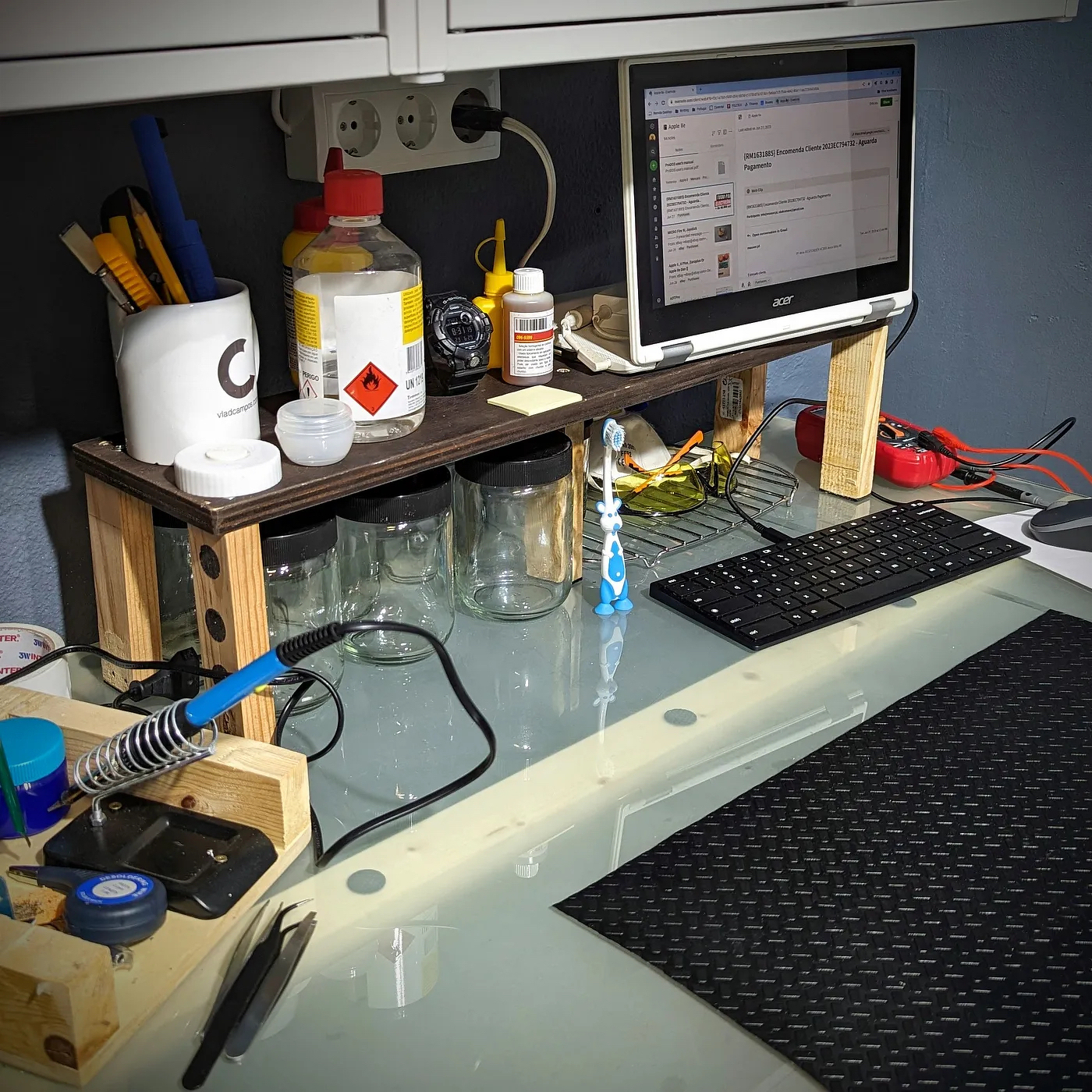
But there are more repurposed materials. The desk itself is made up of the top glass of an old kitchen table, supported by some cheap Ikea trestles. As for that Chromebook, it will not get Chrome OS updates anymore, but it is still good enough for Google searches and the Evernote web client.
So, the next time you are working on a complex project, don’t be too hard on yourself. Every so often, a little mess is what you need to unlock a solution that was always there, but you couldn’t see.
By the way, switching to another project also works, but that’s a story for another time.
Generations
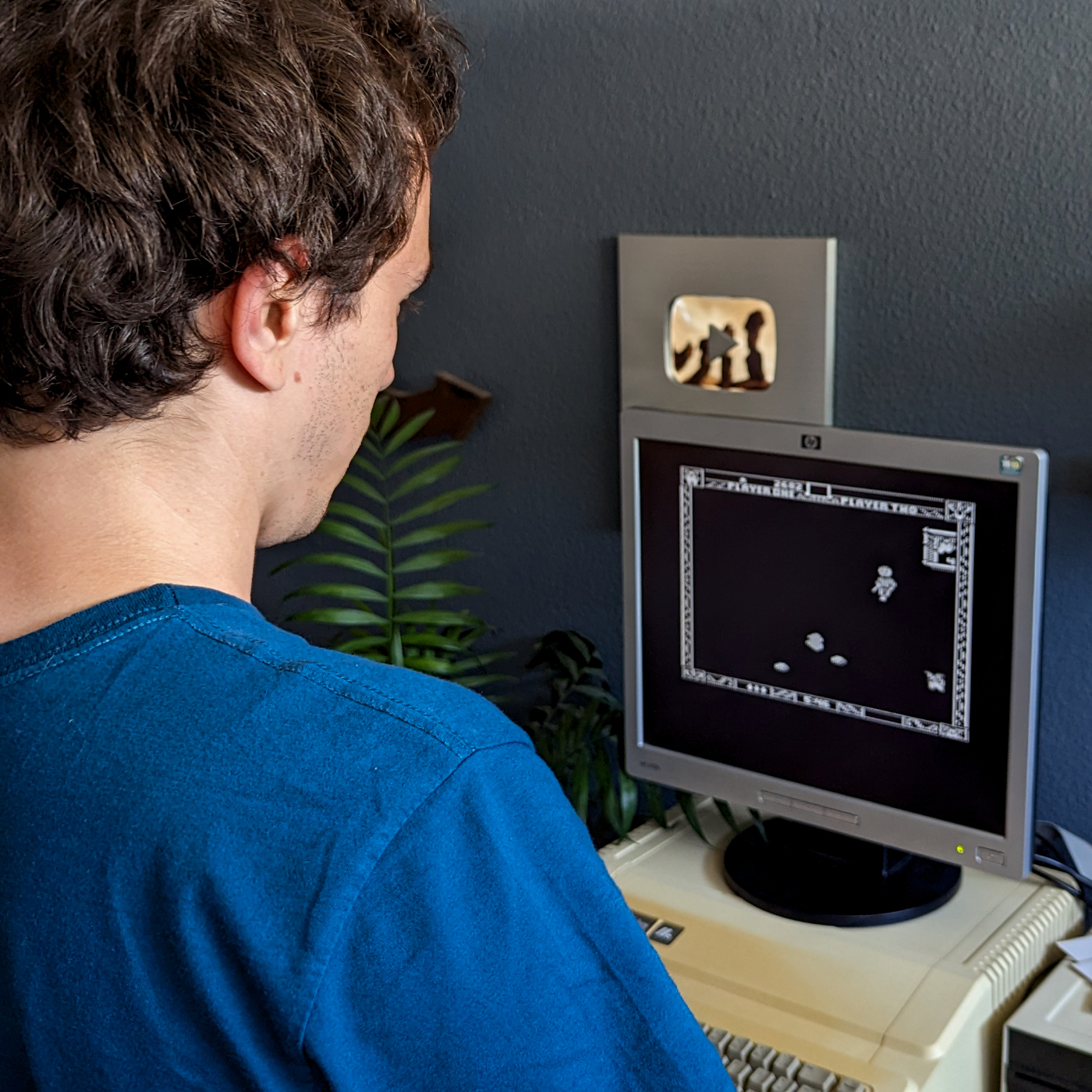
After helping me fix the issue with the ROM chips a few weeks ago, my son got to play Gremlins on the Apple IIe.