The em dash is not an AI thing — have you ever read a book?
2026-02-05 09:07
A few days ago, while listening to episode 658 of the 99pi podcast, I was stunned to learn that people are relating em dashes to ChatGPT and even calling them the ChatGPT dash. What?! Don't these people read books?
Then, when the next podcast in the queue started — I was probably being hunted by an AI ghost at that point — the TWiT hosts began the episode also talking about "the dash thing."
— No! Please, no.
It might come as a shock to those who never opened a book, but authors have been using them for centuries.
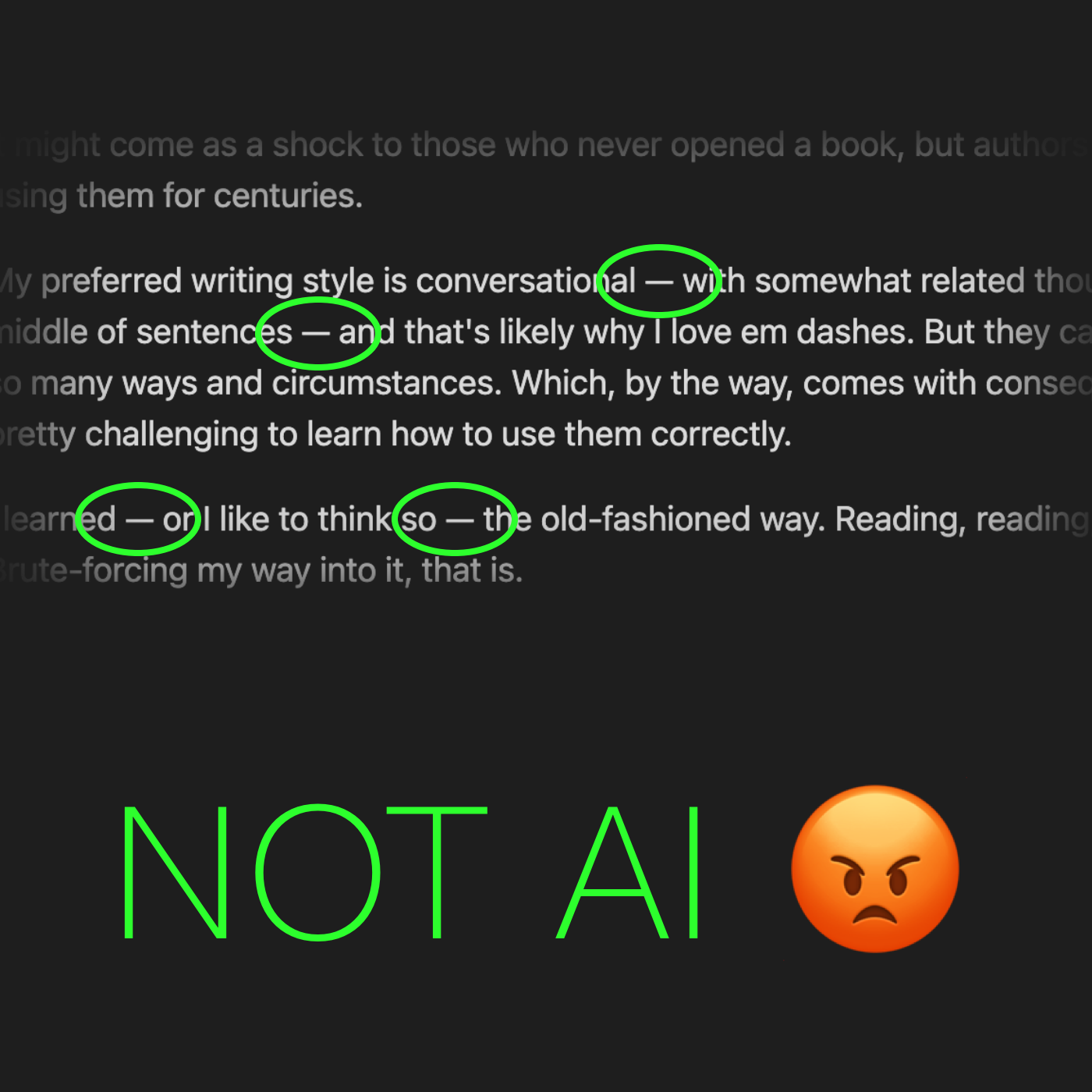
My preferred writing style is conversational — with somewhat related thoughts in the middle of sentences — and that's likely why I love em dashes. But they can be used in so many ways and circumstances. Which, by the way, comes with consequences — it's pretty challenging to learn how to use them correctly.
I learned — or I like to think so — the old-fashioned way. Reading, reading, and reading. Brute-forcing my way into it, that is.
My preferred author — Fernando Sabino — used it a lot. And if I'm being honest, as a teen I couldn't really tell what to do every time I faced that horizontal line in the middle of a sentence. I even remember bookmarking pages where it appeared to compare them to learn how to read a sentence with that strange symbol. So, at least in my case, I'd say that the mystery is part of its beauty.
Because all these books were printed the old-fashioned way, it took me a long time to perceive there were different dashes — I mean their sizes. To this day, I use em dashes for dialogues as well. It's my thing as an author — I guess.
By the way, after many years of use, Shift + Option + - became ingrained in my muscle memory. Together with Shift + Option + 2 for the Euro currency symbol, these are the two keyboard shortcuts I use all the time on my Mac's US-International keyboard.
But there's one thing I never got. Since the beginning of the spellchecker era, many of them keep suggesting I use the em dash connected to the words next to them. The books I read — in Portuguese or English — usually leave blank spaces around them, and that's the style I like. But because the spellchecker kept putting that annoying curly underline below them, I kept accepting the correction.
Well, while writing this, I just realized I don't need to do that. If there's any good coming from this ordeal, it's the fact that I remembered the obvious option — power? — I have to disable spellchecker rules.
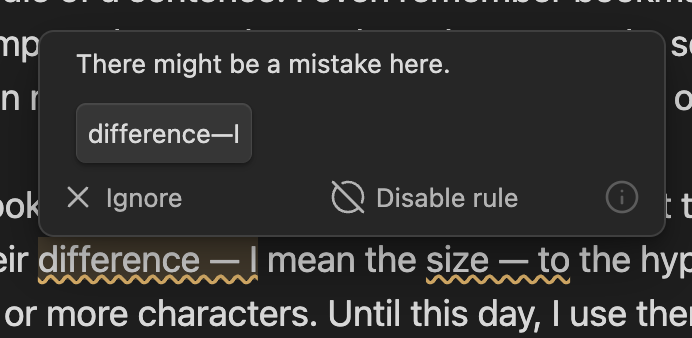
Every so often technology, automation, and currently AI make us forget that — at least for now — we are the ones in control. My blog, my rules.
P.S. If someone ever accuses me of using AI to write my texts, I'll reply with, "Have you ever read a book in your life?"