My backup communication system is ready for the next blackout.
2026-11-15 10:26
We are so used to knowing in real time what's happening everywhere around the globe, but the truth is that's not guaranteed and it can go away in the blink of an eye.
A little over a year ago, when lights and communication systems went out across Portugal, Spain, and parts of France for many hours, I had a taste of how real isolation and uncertainty are when the modern communication system we rely on goes dark.
That made me start looking for alternatives, and a year later, in April 2026, I learned that a technology I fell in love with decades ago, was deployed and in use all across Europe and in many parts of the world. People were setting up and using MeshCore and Meshtastic networks everywhere. In some cases, in response to the April 2025 incident.
Fast-forward to November 2026, a storm called Charles put Portugal's mainland under a state of alert. This time I had LoRa radios running MeshCore. So I thought of tracking the conversations to test the backup network I've been investing time in since last year's outage.
The network
Before we go ahead, I have to talk about this never-ending dilemma: MeshCore or Meshtastic. Both networks and people building them are incredible. There are many reasons I went back to MeshCore; one of them is the infrastructure that was built in Portugal and many parts of Europe. I like that and how messages can travel long distances.
I have no intention or illusion of replacing the mobile network. Although that would be really cool. This personal endeavor is a backup setup that can help me know what's going on in other parts of the country and Europe, in case April 2025 ever happens again. Which is also a great excuse to have a lot of fun along the way. And fun, I'm having. Lots of it!
Even though I've been doing this for so long now, it still boggles my mind that two working networks were built so fast and in such an organic way.
What I'm running
I'm in Porto and when months ago I switched back to MeshCore, I set up my system like this. There's a repeater on my balcony at home and another on my office window. A small radio that's paired with my phone is the one I keep in my everyday bag. Finally, there's the one connected to a Raspberry Pi, powered by a system that runs through a battery. That will keep it on for many hours in case of a blackout.
The test I didn't plan
On the 11th of November the government declared a state of alert for the whole mainland. I opened the MeshCore public channel and left it running. What happened next is why I trust this now.
From half past nine in the morning until almost two, the Portuguese public channel became a spontaneous situation report. Nobody scheduled it, but people kept posting reports: location and weather conditions from many parts of the country. At some point a station announced "maximum silence, prioritizing emergency traffic", and the others went quiet. For a while, at least.
I was monitoring all these messages at home, via the radio connected to my phone. And they were coming from everywhere. Many from Lisbon and cities nearby, but what actually surprised me were the two that came from Galicia. One came from a fixed station up north. The other came from someone on the road, driving toward Ourense. I copied the path information from both conversations and asked AI to draw the routes below.
It's so cool to see the messages hopping on the map. Especially because I've been to Galicia so many times. It's like I can see them making their way down to Porto.
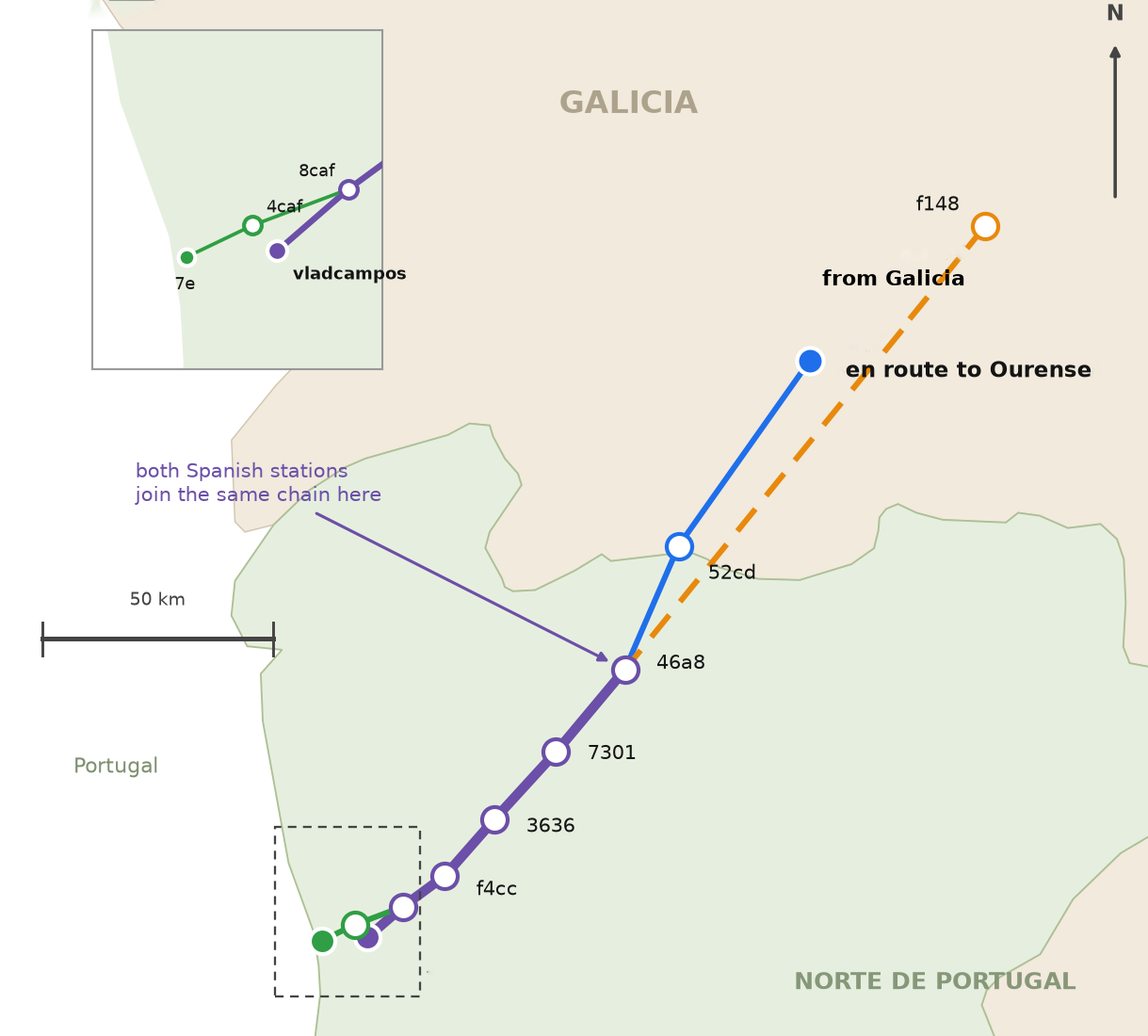
About the Map (2026-11-11) — Only the two ends of each path, the stations in Galicia and vladcampos, are at known places. The paths show hop order and labels, not coordinates, so every open circle is placed along a plausible corridor: the sequence is exact, the ground trek is inferred. Read the lines as the order of handoffs, not as the literal radio path. Both chains converge at the same repeater in northern Portugal before splitting again at the Porto end.
I already know for a fact that messages could travel this far, because I've been trying to send messages back to the radio connected to the Pi every time I go on a trip. In June, one of them traveled 256 Km.
But I have to be honest here, because this is where people start lying to themselves. I tried it again many other times, but that was the only successful attempt so far. However messages from other people never stopped coming. And they arrive in droves. The public channel is very active.
If you're a The Expanse fan, their devices work based on a mesh network. That's how they can talk to each other anywhere even on a planet with no communication infrastructure. It's also why sometimes there's no way to reach the other person they are trying to get in touch with.
Because I was getting so many conversations from Lisbon and region, I also shared some of the path with AI and that's what you see on the map below.
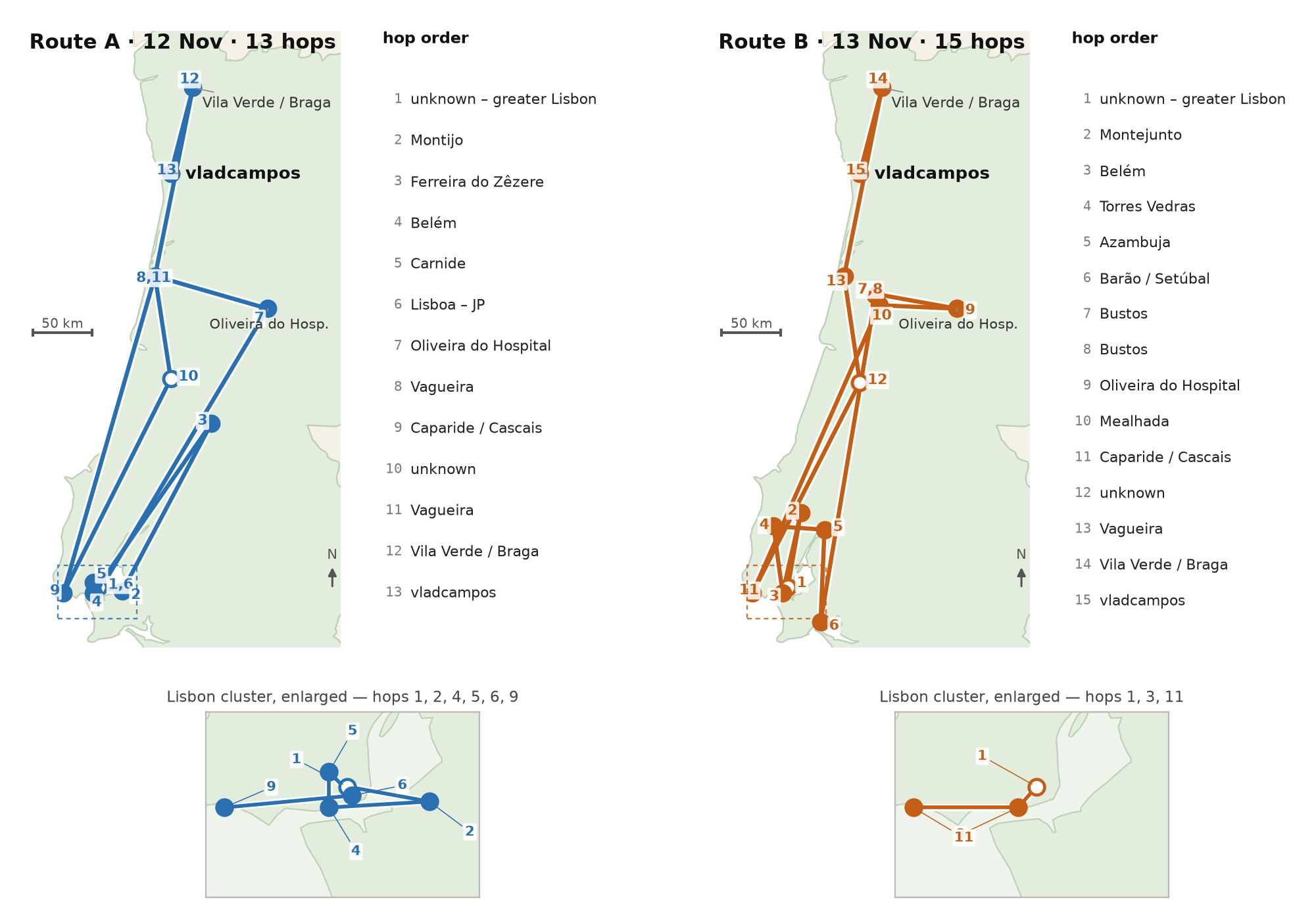
About the Map (2026-11-11) — Only vladcampos is at a known place here; the sending station shows up as "unknown – greater Lisbon". The path shows hop order and labels, not coordinates. Lines follow the sequence of handoffs; the ground track is estimated. On this one, some of the back and forth may be wrong: with so many repeaters in the country, some end up sharing the same code. It's a technical limitation of the 1-byte hop identifiers. I've already updated my repeater configuration and people across Portugal are doing the same, so future maps will be more accurate.
What I learned so far with my experiments is that I already have the backup system I was looking for. Now, the optimist — delusional? — in me is thinking that if the network keeps growing at this pace, maybe we'll get to the point where The Expanse is. LoRa radios are only capable of short text, but wouldn't it be cool to be able to communicate with everyone without relying on a central infrastructure?
Remember when the pelican in Finding Nemo passed along a message that Nemo was in the dentist's office? Different species kept the message going until it reached the rescue crew. The fact that I can get messages from Spain means that news can be passed along across Europe like that, but hopping from one city to the other. Even if a message can't technically travel across the continent, the current network infrastructure means that at least the news can reach me. And vice versa.
Come on board!
This is such a low barrier hobby to start. The radios themselves are so cheap. Even the ready to use kits are not that expensive. Get the cheapest pair you can find and start having fun. If you enjoy this kind of project, you'll probably keep adding new gadgets to the mix, but even if you start building a catastrophe reliant system, it's not going to be expensive.
Upgrades
I started this project with only two radios, but regardless of what system I'll be running in the future, a backup network is only useful if it can stay up and running during an outage. And I still have work to do on that front.
My home repeater has a battery but no solar panel. So, if I lose power, it will last for about 10 hours and then go dark. That's not good for me, nor for the community. So, next item on the list is to make that a reliable connection point in the network.
My every-day radio also lasts for about 10 hours and can be recharged using a power bank. Which is also something I can do as a last case scenario on my repeater. As for the one connected to the Pi, it will probably last longer on its two 18650 batteries.
Now, the repeater at my office was set there as a test, and it doesn't even have a battery. There's a lot of work to do there, as that one will go down as soon as power is lost.
Regarding the software and hardware in general, I'd love to see more dedicated devices with long duration batteries. Currently, most radios are companion devices that need a screen and keyboard borrowed from our phones to work.
There are already some standalone devices that look like Blackberries. But what I would really like to see are phones with LoRa radios. This would make things much easier. We would be able to use our phones as we do today and in case the network goes down, it will already be capable of using the mesh network. And, of course, tinkers like me would have a cool toy always ready to have fun with.